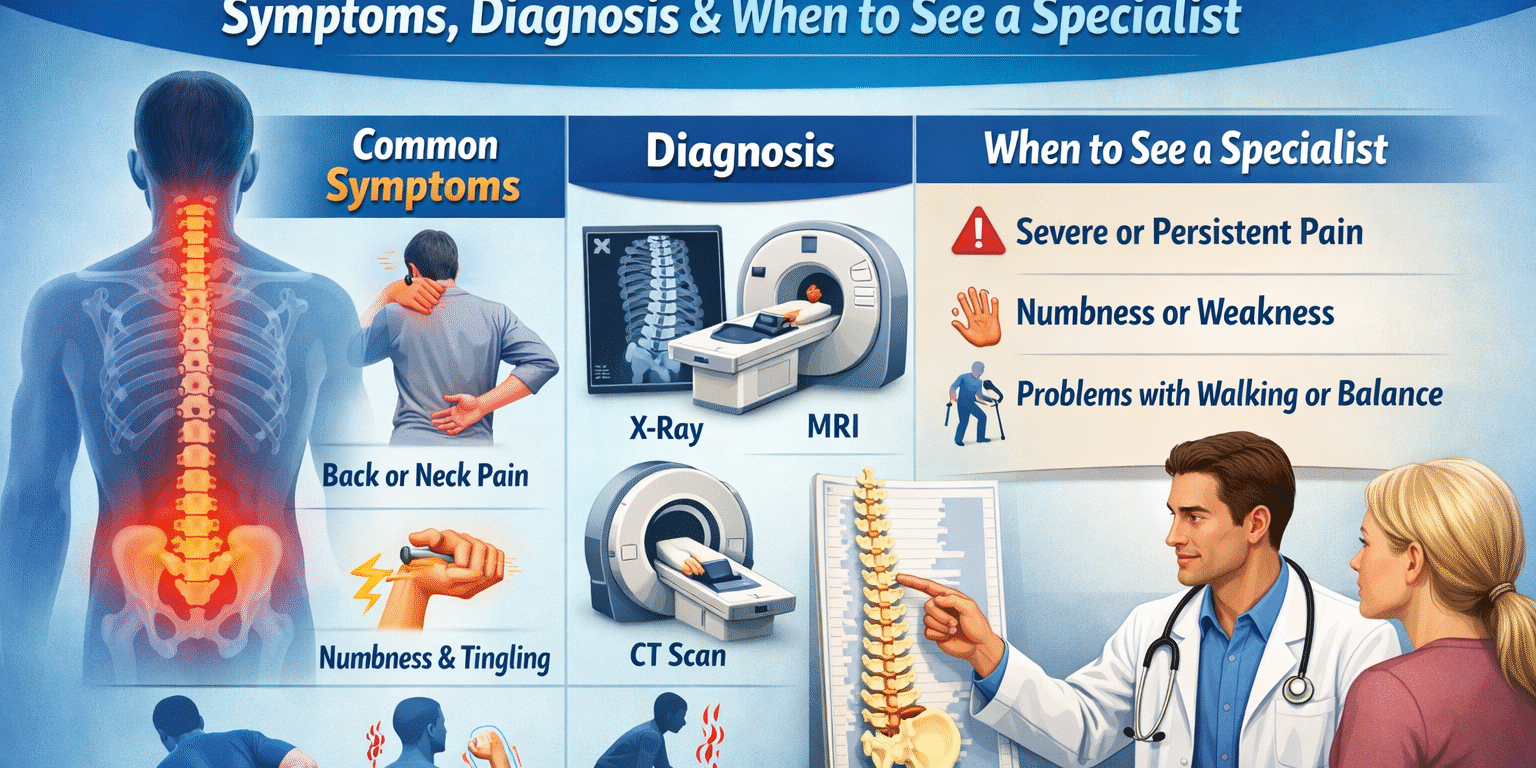
Understanding your spine symptoms and diagnosis early can avoid nerve damage that won’t go away, losing your mobility, and expensive surgeries. Keep reading, because it might make your life better.

Did you know? According to the WHO in 2020, low back pain (LBP) affected 619 million people globally, and it is estimated that the number of cases will increase to 843 million cases by 2050. This made it the top cause of disability in the world. Still, millions of Indians keep ignoring the signs until the situation gets very bad. Experts like Dr Raveeesh Sunkara emphasise that early recognition of spinal disorders is the most important thing for timely recovery.
Key Takeaways
- If your back pain lasts for more than 4–6 weeks, you should never just take painkillers; you should see a doctor for a proper spine evaluation.
- Neck pain is often caused by more than just bad posture, and imaging is needed to accurately diagnose cervical disc disease and stenosis.
- If you have early signs of a spinal issue like tingling, weak legs, or trouble keeping your balance, you need to see a doctor right away.
- If you have neurological signs of a spine problem, like not being able to hold your urine or having weak limbs, you need to see a specialist right away.
- If the pain doesn’t go away, neurological symptoms show up, or non-surgical treatments don’t work, you need to see a spine expert right away.
How Recognising Symptoms Shapes Accurate Diagnosis of Spinal Conditions
The spine is more than just a column of bones. It’s where your whole nervous system gets its instructions. The body makes it clear when something is wrong, no matter how small. What was the tragedy? Most people ignore these signs because they think the person is “just tired” or old.
Learning to read those signals is the first step towards recovery.
Common Back Pain Symptoms You Should Never Ignore
Back pain symptoms range from a dull ache to a sharp, burning sensation. Here is what to watch for:
- Persistent lower back pain that doesn’t go away after 4–6 weeks
- Pain that gets worse when you stand, sit, or bend
- A pain that goes down one or both legs and is very sharp
- Morning stiffness that eases after movements
- Pain that wakes you up at night.
Back pain is not all the same. If you have pain below the knee, leg weakness, or pain that doesn’t get better with rest, you need to see a doctor right away.
Neck Pain Causes: More Than Just Poor Posture
These days, sleeping in the wrong position isn’t the only thing that neck pain causes. Some common causes are:
- Degeneration of the cervical disc (spondylosis)
- Slipped or herniated cervical disc
- Whiplash from accidents or sudden jerks
- Poor screen posture (text neck) is a growing problem in Indian youth
- Cervical stenosis is a narrowing of the spinal canal.
When neck pain spreads to the shoulders or arms or makes the fingers tingle, this is a very bad sign. It could mean that a nerve is being pinched, and drugs alone should never be used to treat it.
Early Signs of Spinal Disorders: Don’t Wait for the Pain to Speak Louder
The early signs of spinal disorders are often subtle. A lot of people miss them. These are the most important ones:
| Early Warning Sign | What It Could Indicate |
| Numbness or tingling in arms/legs | Nerve compression or disc herniation |
| Sudden leg weakness | Lumbar disc disease or stenosis |
| Reduced reflexes | Spinal cord or nerve root involvement |
| Loss of bladder/bowel control | Medical emergency, see a doctor immediately |
| Pain after minor activity | Degenerative disc disease |
| Curved or uneven posture | Early scoliosis |
The earlier you catch these signs, the better your chances of avoiding surgery.
Neurological Symptoms of Spine Problems: When the Spine Affects the Nerves
This is where things get serious. Neurological symptoms of spine problems occur when the spine puts pressure on the spinal cord or nerves nearby. These signs and symptoms include:
- Having numbness, burning, or electric shocks in your limbs
- Hands, arms, legs, or feet that feel weak
- Having trouble walking or keeping your balance
- Loss of fine motor skills, like having trouble holding things or buttoning clothes
- Bladder or bowel function.
These aren’t symptoms that can be treated at home. They mean that your nervous system is in danger, and every hour of delay matters.
How Do Doctors Diagnose Spine Conditions?
Proper spine symptoms and diagnosis involve a layered approach. There is no one test that can fully explain everything. This is how doctors usually check out your spine:

Step 1: Do a physical and neurological examination. There are tests your doctor does to see how strong your muscles are and how much you can move. They look at how you stand, walk, and react to touch or pressure.
Step 2: Imaging Tests
- X-rays show how bones are aligned, broken, and changing over time.
- MRI (Magnetic Resonance Imaging) is the best way to see how soft organs, discs, and nerves are involved.
- A CT scan is used when a detailed bone structure is needed.
Step 3: Nerve Function Tests
- Electromyography (EMG): Measures how muscles are electrically active
- Neurological Conduction Studies (NCS): Evaluates how well nerve signals travel.
Step 4: Get blood tests Ankylosing spondylitis, an infection, or bone cancer can be ruled out with this test.
A thorough diagnosis keeps you from getting the wrong diagnosis and makes sure you get the right treatment, whether it’s non-surgical or surgical.
When to See a Spine Surgeon: Powerful Signs You Must Act Now
A lot of people want to know, “When to see a spine surgeon?” Here are the unmistakable signals that your situation needs specialist-level care:
- Pain that won’t go away after 6 weeks of rest and medication
- Feelings of weakness, numbness, or loss of control in the nerves
- The pain that comes after an accident or spinal damage
- If you lose control of your bladder or bowels, you need surgery right away.
- Having trouble walking or standing for short amounts of time
- Pain disrupting your sleep consistently
- A confirmed diagnosis of scoliosis, a herniated disc, or spine stenosis
Do not wait until you can’t move. When a specialist steps in early, non-surgical options are often still possible.
Conservative vs. Surgical Treatment: What Path Is Right for You?
Not all problems with the spine need surgery. Most patients can improve with the right non-surgical plan:
- Physiotherapy and targeted exercises to strengthen the muscles around the spine
- Using anti-inflammatory drugs and muscle relaxants to treat pain
- Lifestyle changes, like losing weight, getting good posture, and setting up an ergonomic office
- epidural steroid shots to relieve pain and inflammation in specific nerves
- Traction therapy for disc decompression
When non-surgical treatments don’t work, neurological problems get worse, or the spinal cord is in danger from structural instability that threatens the spinal cord.
Stop Suffering in Silence, Get Your Spine Assessed by an Expert Today!
If any of the above neurological symptoms of spine problems sound familiar, please don’t delay. The longer you wait, the more complex your treatment becomes.
Dr Raveesh Sunkara is one of the most respected spine doctors in Hyderabad. We have helped over thousands of people get long-lasting relief from their pain, and our success rate is between 80% and 90%. We specialise in both minimally invasive procedures and complicated spinal reconstructions. We give you personalised care that is based on evidence and puts your recovery first. So, visit our website and get a consultation today.